


Preiser HO: expert guide to realistic scene composition
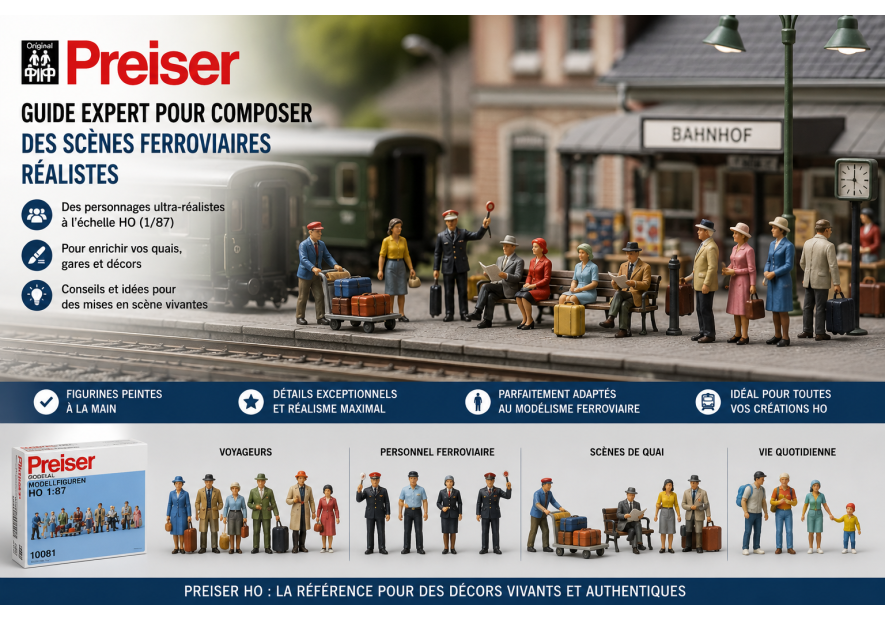
Extended Preiser HO pillar: advanced composition workflow, scenario matrix, practical references and expert FAQ.
Last updated: 2026-07-24
Quick answer
To make HO scenes feel realistic with Preiser figures, treat your layout like a stage: define scene purpose, control density, and balance focal points with breathing space. Realism comes from composition quality, not from adding as many figures as possible.
What makes this a pillar article
Most users ask broad questions such as "which Preiser figures should I buy first" or "how many figures should I place on a station platform". A useful answer must combine product references, placement logic, and practical scene-building methodology. This guide is designed to be that reusable decision resource.
Table of contents
- Scene readability fundamentals
- 6-step figure planning workflow
- Density planning matrix by zone
- Three practical layout scenarios
- Preiser reference packs by objective
- Common visual mistakes and fixes
- Cross-links for deeper planning
- Expert FAQ
1) Scene readability fundamentals
Readable scenes share three properties:
- Clear narrative intent: people waiting, boarding, working, shopping, or crossing.
- Directional diversity: avoid groups all facing one direction.
- Layered focus: one dominant focal cluster, then secondary supporting groups.
When every figure has equal spacing and equal orientation, the eye detects artificial repetition quickly. A better approach is asymmetrical grouping with varied interpersonal distance and line-of-sight direction.
2) 6-step planning workflow
- Define era and operational context of your layout segment.
- Split the area into functional micro-zones (platform, entrance, maintenance edge, street frontage).
- Assign figure roles to each zone (travelers, passers-by, staff, workers).
- Set target density for each micro-zone before placing figures.
- Place main focal groups first, then add secondary connectors.
- Do a "2-meter test": step back and check if scene intent is instantly readable.
3) Density planning matrix
| Micro-zone | Figure profile | Density target | Main visual goal |
|---|---|---|---|
| Main station platform | Travelers standing + seated | Medium/High | Boarding and waiting rhythm |
| Station forecourt | Passers-by and merchants | Medium | Urban transition energy |
| Operational edge | Railway personnel | Low/Medium | Railway credibility |
| Maintenance corner | Work crews | Low focused | Narrative realism without clutter |
4) Practical scenarios
Scenario A: compact regional station
Use one main traveler cluster, one seated bench pair, and one staff anchor near operation equipment. Keep one quieter section to avoid visual saturation.
Scenario B: station plus street life
Blend passers-by and merchants around the station entrance. Use crossing movement vectors to create natural flow toward rail activity.
Scenario C: operations-focused module
Keep traveler density lower and reinforce railway staff presence. This improves plausibility when locomotives and servicing are central to the story.
5) Preiser references by objective
- Passenger base: Preiser 14142 Travelers
- Waiting scene: Preiser 14004 Seated passengers
- Street life: Preiser 14022 Passers-by
- Market/interaction: Preiser 14042 Merchants and passers-by
- Work zone: Preiser 14017 Work crew
- Railway operations: Preiser 14014 Railway staff
6) Common mistakes and corrections
- Overcrowding all areas equally. Fix: define density hierarchy per zone.
- Mirror-like orientation repetition. Fix: rotate figure axes and distances.
- No functional zoning. Fix: assign explicit scene role before placement.
- Too many focal points. Fix: keep 1 primary and 2 secondary focuses max.
7) Related resources
- Brand: Preiser
- Category: HO characters
- Related guide: Build your first model railway
- Related guide: How to choose tracks
- Related pillar: Roco/Rocoline tracks and turnouts
Sources and method
This guide is built from live Preiser references on univers-train.com plus practical scene-design principles used for readable HO storytelling and era-consistent composition.
Preiser HO FAQ
How many figures should I place on one HO platform meter?
There is no fixed number. Start moderate, then add only where scene narrative requires emphasis.
How can I make scenes feel less static?
Use directional variety, different spacing, and interaction clusters with distinct posture logic.
Should I fill every sidewalk section?
No. Empty zones improve rhythm and increase focal contrast where action happens.
Can I mix staff and passengers in one segment?
Yes, if micro-zones stay functionally clear and visually separated.
What starter set is most versatile?
Travelers + passers-by + staff gives a flexible base for station, street, and operational scenes.
J+7 - 2026-07-24: Quick scene heuristic: alternating dense clusters with visual breathing space improves realism more than using the same figure density everywhere.
Related pillar: Roco/Rocoline tracks and turnouts.
