

How to choose the tracks for your model railway?
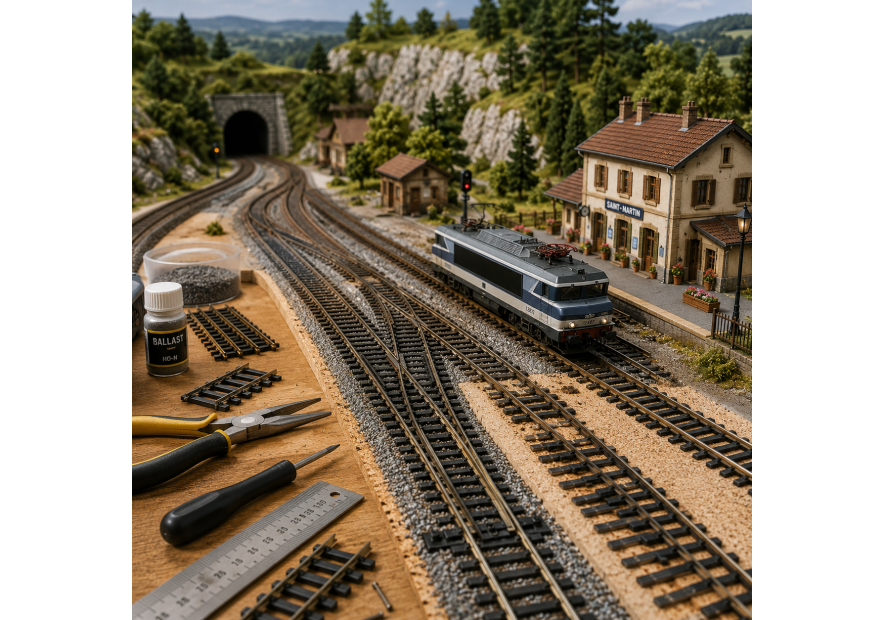
Choosing the right track is a crucial step in building a model railway. Discover the different types of track, curve radii, switches, and our tips for creating a reliable, realistic, and expandable layout.
Last updated: 2026-07-23
Quick answer
To choose model railway tracks correctly, confirm scale, minimum radius, operating style (shunting or continuous running), and turnout compatibility first.
Action summary
- Define a track plan and minimum curve radius.
- Check turnout compatibility with your rolling stock.
- Test a pilot loop before full expansion.
How to choose the tracks for your model railway?
Track is the foundation of any model railway. Choosing the right track from the start ensures smooth train movement, facilitates future expansion, and contributes to the realism of your layout. Today, there are several types of track available, suited to different scales and all skill levels.
The different types of roads
Manufacturers generally offer two main types of tracks:
- Ballasted tracks , easy to install and ideal for beginners.
- Conventional or flexible routes , preferred for realistic and customized networks.
Ballasted tracks allow for quick assembly, while flexible tracks offer greater freedom in the design of curves and layouts.
Choosing the correct radius of curvature
The radius of curves is a determining factor for the proper functioning of the network. Curves that are too tight can cause derailments or limit the circulation of certain locomotives and long carriages.
When space allows, always favour the most generous radii in order to obtain a smoother flow and a more realistic rendering.
The switches
Switches allow for the creation of branch lines, sidings, or stations. They must be carefully chosen to ensure reliable train operation.
- Right-hand switch
- Curved switch
- TJD (Double Junction Crossing)
- Simple crossing
The choice will depend primarily on your network plan and the available space.
Provide for the power supply
Even on a modestly sized network, it is recommended to distribute several power supply points to ensure a homogeneous power supply across all tracks.
This precaution significantly improves operational reliability, particularly on digital (DCC) networks.
Think about future developments
When designing your network, always leave room for the addition of new tracks, an extra station, or an industrial area. A well-designed network can evolve for many years without requiring complete reconstruction.
Choose carefully according to your scale
Each scale has its own ranges of track. The most common are HO (1:87) and N (1:160), but there are also solutions for O, Z or HOm scales.
Always ensure that you choose rails that are compatible with your rolling stock and power supply system.
Our advice
For your first layout, choose a complete track system from a single manufacturer. You'll benefit from optimal compatibility between the rails, turnouts, and accessories, while also facilitating future expansions of your installation.
Also worth discovering
- How to build your first model railway
- HO, N, O or Z: which scale to choose?
- How to get started in model railroading
At Univers Train , you will find a wide selection of tracks, switches and accessories from the biggest brands to build a reliable, scalable and realistic layout, whatever your level.
Related guides
Sources and method
- Comparison of track and turnout geometries.
- Scale and rolling-stock compatibility checks.
- Practical validation on a test layout.
Track selection FAQ
What is the first criterion when choosing track?
Scale is the first criterion because it drives curve radius, footprint, and rolling stock compatibility.
How do I avoid issues in curves?
Use a minimum radius that matches your longest vehicles and test critical routes before final installation.
Should I start with a simple loop?
Yes. A pilot loop helps validate power, running quality, and turnout behavior before expanding the layout.
