


Railway eras: understanding eras I to VI
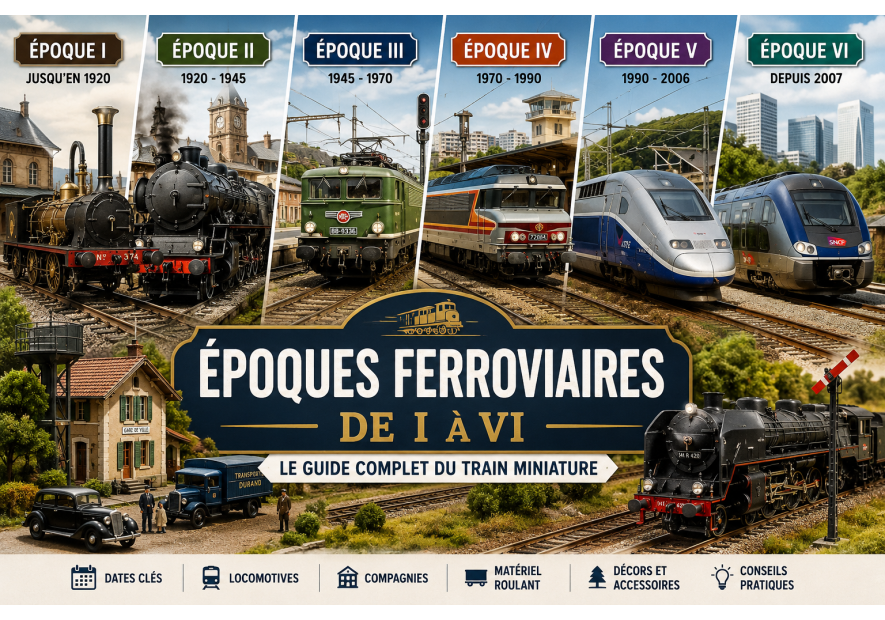
The six major railway eras allow for the faithful reproduction of a period in railway history on a miniature network.
The different eras of railways explained: the complete guide to choosing your model train
In model railroading, railway eras help to place rolling stock in its historical context. They provide an excellent reference point for choosing locomotives, passenger cars, wagons, but also buildings, road vehicles and accessories consistent with the period represented.
Whether you're a beginner or a long-time enthusiast, understanding the different eras will help you create a realistic and harmonious model railway. In this guide, discover the characteristics of eras I through VI, their dates, their technological developments, and their iconic equipment.
Why are railway eras important?
Model train manufacturers faithfully reproduce the equipment that actually ran during a given period. Mixing models from different eras is certainly possible, but a layout dedicated to a single period will offer a much more realistic experience.
The different eras have a significant influence, in particular:
- the locomotives;
- passenger cars;
- freight wagons;
- the liveries of the railway companies;
- buildings and stations;
- the signage;
- road vehicles;
- the characters and the street furniture.
Summary table of railway eras
| Era | Period | Main features |
|---|---|---|
| I | Until 1920 | Private companies, steam locomotives, the beginnings of the railway. |
| II | 1920 to 1945 | Modernization of networks, creation of the SNCF, steam power dominant. |
| III | 1945 to 1970 | Reconstruction, coexistence of steam, diesel and electric power. |
| IV | 1970 to 1990 | Gradual disappearance of steam, widespread adoption of diesel and electric power. |
| V | 1990 to 2006 | High speed, new liveries, opening up to competition. |
| VI | Since 2007 | Digitization, private operators, modern and interoperable equipment. |
Era I: The beginnings of the railway (until 1920)
Era I corresponds to the birth of the railway and its rapid development in Europe. Railway companies are still private and each operates its own network with locomotives, carriages and wagons in specific colours.
In France, several large companies share the territory:
- PLM (Paris-Lyon-Mediterranean)
- Northern Company
- Eastern Company
- Paris-Orléans (PO)
- Compagnie du Midi
- State network
Locomotives of Era I
Steam reigns supreme. The locomotives boast elegant silhouettes, with large driving wheels, riveted boilers, and numerous brass details. Separate tenders are very common.
Performance remains modest, but these machines mark the beginning of a true revolution in transportation.
Rolling stock
Passenger cars are generally short and compartmentalized. The wagons are mainly constructed of wood and most often have two axles.
The traffic consists mainly of agricultural, industrial and mining goods.
The setting
A network from Era I is characterized by a very authentic atmosphere:
- stone train stations;
- mechanical semaphores;
- roads with few traffic;
- horses and carts;
- first automobiles.
This period appeals to enthusiasts of old steam locomotives and traditional railway architecture.
Era II: Modernization and creation of the SNCF (1920 to 1945)
Era II marks a period of profound changes. Railway networks become more efficient while locomotives become more powerful and reliable.
In France, the major event was the creation of the SNCF in 1938, which brought together the main railway companies under a single national entity.
A still dominant vapor
The steam locomotive remains the standard. The famous Pacific, Mikado, and Mountain locomotives pull both passenger trains and freight trains.
Their power increases considerably and performance reaches unprecedented levels.
The beginnings of electrification
Some lines are beginning to be electrified, particularly in mountainous regions where electric locomotives offer better performance.
Diesel, on the other hand, remains very discreet.
Rolling stock
Passenger cars are gradually becoming made of metal and offering greater comfort. Wagons are also gaining in capacity to keep pace with industrial development.
The setting
Landscapes evolve with:
- more cars;
- the first modern trucks;
- factories in full development;
- improved signaling.
Era III: The Golden Age of the Railway (1945 to 1970)
For many enthusiasts, Era III represents one of the finest periods in railway history. After the Second World War, the networks were rebuilt and experienced tremendous growth.
This era is particularly popular in model railroading because it allows three major families of locomotives to run simultaneously.
Steam reaches its peak
The last of the great steam locomotives still haul fast trains, express trains, and freight trains. They offer exceptional performance while retaining the charm of steam traction.
The arrival of diesel
Diesel locomotives are gradually appearing on main and secondary lines. They require less maintenance, start up more quickly, and are gradually replacing steam engines.
The development of electric
The electrification of main lines is accelerating. Electric locomotives are becoming increasingly numerous and herald the modernization of the French rail network.
Why choose era III?
Era III is particularly popular with modelers, as it offers a huge choice of rolling stock and allows for the reproduction of very varied scenes.
- coexistence of steam, diesel and electric;
- very large selection of miniature locomotives;
- numerous passenger wagons and carriages available;
- urban and rural networks;
- rich historical heritage.
It remains today one of the periods most represented by model train manufacturers.
