



Minimum HO curve radius: locomotive and coach practical guide
Practical guide to choose HO curve radius by rolling stock type and avoid derailments and layout design mistakes.
You need to pick a curve radius for your HO layout and want to avoid derailments, coupler stress, and unrealistic overhang. This guide helps you choose a practical radius based on your rolling stock, available space, and operating goals.
Key point: the minimum radius that allows a train to move is not always the radius that delivers reliable day-to-day operation.
1. Why curve radius matters on an HO layout
Curve radius directly affects:
- overall track-plan footprint;
- running behavior of locomotives and coaches;
- stress on couplers, buffers, and gangways;
- derailment risk at curve transitions;
- visual realism, especially overhang on long vehicles.
The longer the vehicle, the more sensitive it is to tight curves, especially full-length passenger coaches and long locomotives.
2. Understanding HO curve radius
Radius vs diameter
Radius is measured from the center of the circle to the track centerline. Diameter is twice the radius.
- 360 mm radius = 720 mm diameter
- 420 mm radius = 840 mm diameter
- 500 mm radius = 1,000 mm diameter
Real footprint requirements
In practice, you must add safety margins: baseboard edge clearance, parallel-track spacing, platform offsets, and side clearances for overhang. A theoretical 840 mm loop often needs significantly more usable width.
Why identical radii can behave differently
Performance also depends on track laying quality, transition geometry, coupler design, bogie articulation, and the length of your stock. Radius alone is not enough.
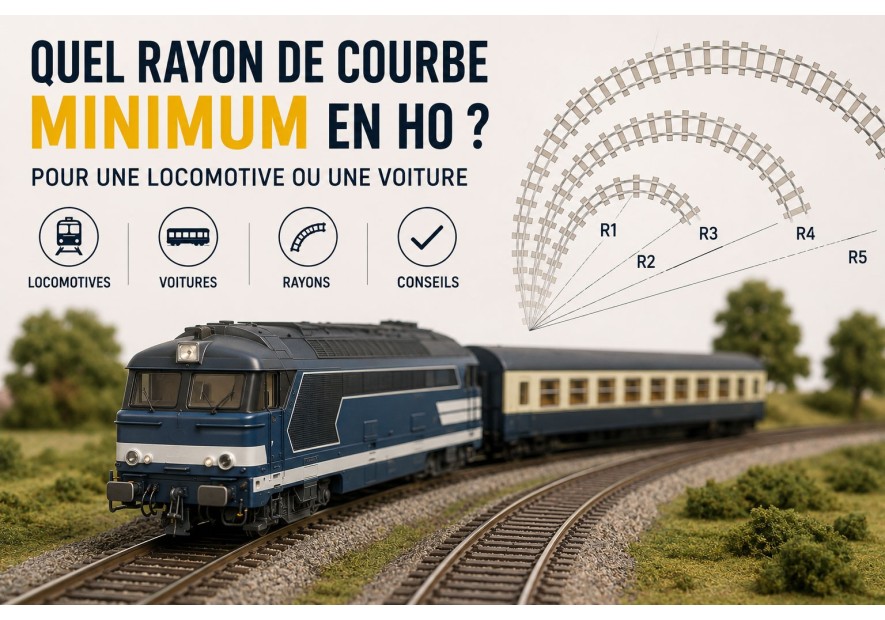
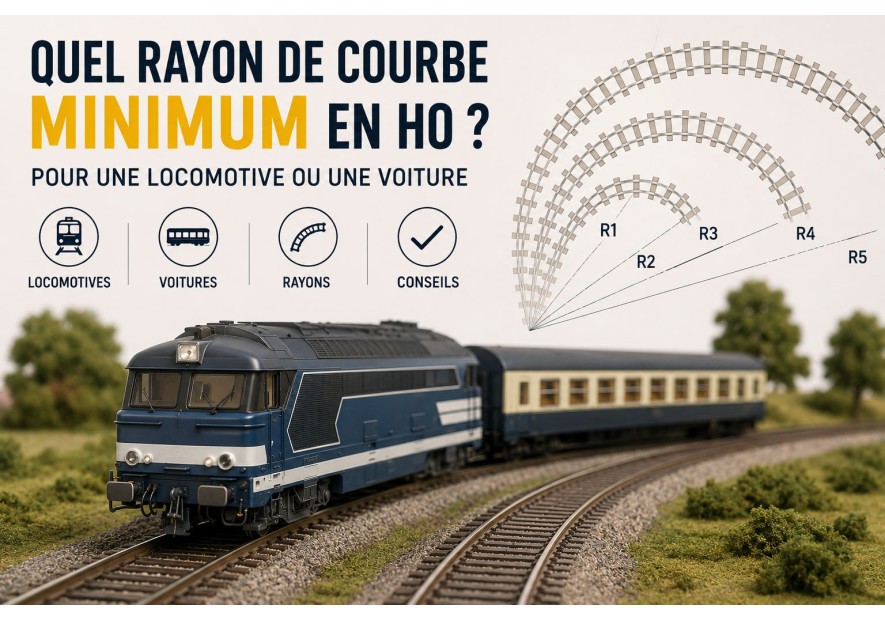
3. R1, R2, R3, R4, R5: what these labels really mean
R1 to R5 are useful product labels, but they are not universal standards. Actual dimensions vary between manufacturers and track systems.
Important: never assume one brand's R2 equals another brand's R2. Always check the exact track reference and technical specs.
4. Minimum radius by HO rolling-stock type
The table below provides practical guidance. Exact limits depend on each model, so always verify the manufacturer's minimum radius recommendation.
| HO rolling stock type | Recommended radius (reliability and visuals) | Possible minimum (model-dependent) | Risks on tight curves |
|---|---|---|---|
| Small bogie locomotive | 420 mm and above | 360 mm possible on some models | Coupler stress, speed instability, sensitivity to small track defects |
| Long electric locomotive | 500 mm and above | 420 mm sometimes possible | Visible overhang, transition instability, reduced realism |
| Diesel locomotive | 420 to 500 mm depending on length | 360 to 420 mm depending on model | Mechanical strain, noise, traction effort increase |
| Steam locomotive | 500 mm and above | 420 mm for some compact models | Running-gear stress, visible lateral displacement |
| Short coach | 420 mm and above | 360 mm possible | Tight spacing and coupler tension |
| Long passenger coach | 500 to 550 mm and above | 420 mm on some compatible models | Buffer/gangway contact, derailment in reverse, heavy overhang |
| Double-deck coach | 550 mm and above | 500 mm sometimes possible | Side-clearance conflicts with platforms and structures |
| Short freight wagon | 360 to 420 mm | 360 mm often possible | Usually tolerant, but still sensitive with rigid couplers |
| Long freight wagon | 420 to 500 mm | 360 to 420 mm depending on design | Derailment risk in tight S-curves, drawgear stress |
5. Long passenger coaches: the special case
Long coaches combine multiple constraints: stronger overhang, longer bogie spacing, higher coupler travel, possible buffer interference, and larger side clearances near platforms and scenery.
If your layout focuses on long passenger trains, a larger radius is usually the safest design decision.
6. Choosing radius by layout size
Small layout
Focus on compactness, but validate every long vehicle before committing.
Starter layout
Prioritize reliability. A moderate radius with some margin is usually better than the absolute minimum.
Medium layout
Use larger radii on main visible lines, and reserve tighter curves for secondary areas where appropriate.
Large layout
Aim for broader curves to improve both realism and operational flexibility.
7. Calculating loop space
Simple method:
- Calculate diameter: radius x 2.
- Add side safety margins.
- Add spacing if you run parallel tracks.
- Add room for platforms, catenary masts, and nearby structures.
| Radius | Geometric diameter | Practical footprint (typical range) |
|---|---|---|
| 360 mm | 720 mm | about 820 to 950 mm depending on margins |
| 420 mm | 840 mm | about 940 to 1,100 mm depending on margins |
| 500 mm | 1,000 mm | about 1,100 to 1,300 mm depending on margins |
8. Common mistakes to avoid
- Using very tight curves with long coaches.
- Planning by diameter only and forgetting real-world margins.
- Mixing track systems without geometry checks.
- Ignoring side-clearance envelope in curves.
- Placing platforms and structures too close to curved track.
- Testing with short trains only, then running long rakes later.
9. How to test a curve before final track fixing
- Lay the curve temporarily.
- Run your longest locomotive.
- Run your longest coaches, alone and in a full rake.
- Check couplers in pull and push movements.
- Check clearance around platforms and obstacles.
- Test at low speed, then at normal operating speed, both directions.
10. What radius is best for a realistic HO layout?
The right radius is not simply the biggest you can fit. It is the best compromise between available space, rolling-stock compatibility, reliable operation, and visual realism.
Start from your most demanding vehicle and design the plan around a radius that leaves you a real reliability margin.
FAQ: HO curve radius
What is the minimum HO curve radius?
There is no single value for every train. It depends on model design, couplers, and track system. Always verify manufacturer data.
Can long coaches run on R1?
Some models can, but with higher risk of overhang issues and unreliable running. A larger radius is usually safer.
What is the difference between R1 and R2?
R2 is generally larger than R1, but exact dimensions vary by brand.
What radius for an HO electric locomotive?
Long electric locomotives benefit from broader curves. Minimum values may work, but with less operating margin.
What radius for an HO TGV trainset?
Long articulated sets usually require larger radii for stable and realistic operation. Check the exact model recommendation.
Can I mix different radii?
Yes, provided transitions are smooth and tight S-curves are managed carefully.
Why does my train derail in curves?
Typical causes are too-tight radius for the stock, track defects, poor transitions, coupler stress, and insufficient side clearance.
Related guides
- How to choose the right track for your model railway
- How to build your first model railway layout
- HO through-station track plan: complete method
- Roco/Rocoline: expert guide for tracks, radii and turnouts
- Analogue DC or digital DCC: which should you choose?
- HO layout signalling: blocks and feedback
- HO, N, O or Z: which scale to choose?
